

Accountants with prettier decks
The mediocrity loop of performance marketing


I’ve talked about the broader problems of creative advertising and the agency model. Now I want to focus (again) on the performance marketing side that I have the opportunity to watch very closely.
I think we are coming to a dangerous place in advertising. Even though we have capabilities that are incomparable to what we had in the past, we’re using them to work in the same methods. The only difference from what we’ve been doing ten years ago is that we are doing it on a much much larger scale.
The circle of sameness is closing. It’s becoming smaller and smaller. Pretend iteration is becoming more and more obviously useless. Sure, you’re testing A and B - but what is your hypothesis? A/B testing only works if you’re trying to prove or disprove something. If that something is whether a copy of your competitors’ ad is going to work, then that’s not much of a hypothesis.
A bit of history
Let me start a while back, when I started working with Facebook marketing and Facebook advertising. What we did almost immediately was understand that the differentiator from the traditional advertising of the day was that you could measure everything. That was a big selling point, because most of the other channels available back then (around 17 years ago) were much more cloudy in their measurements. On Facebook, it seemed like everything was very clear: you get likes, you get views, you get impressions, you get engagements… if you don’t, you iterate, and so on.
For a time, that was actually the case. It was interesting to see people’s reactions to different types of content - to see what works, what doesn’t, what starts trending, and how it dies down.
We were very serious back then about this differentiator and worked diligently with advertising tools, developing a lot of them in-house as well. I don’t have a lot to show for that period. I only found this blurry screenshot of one of our tools:
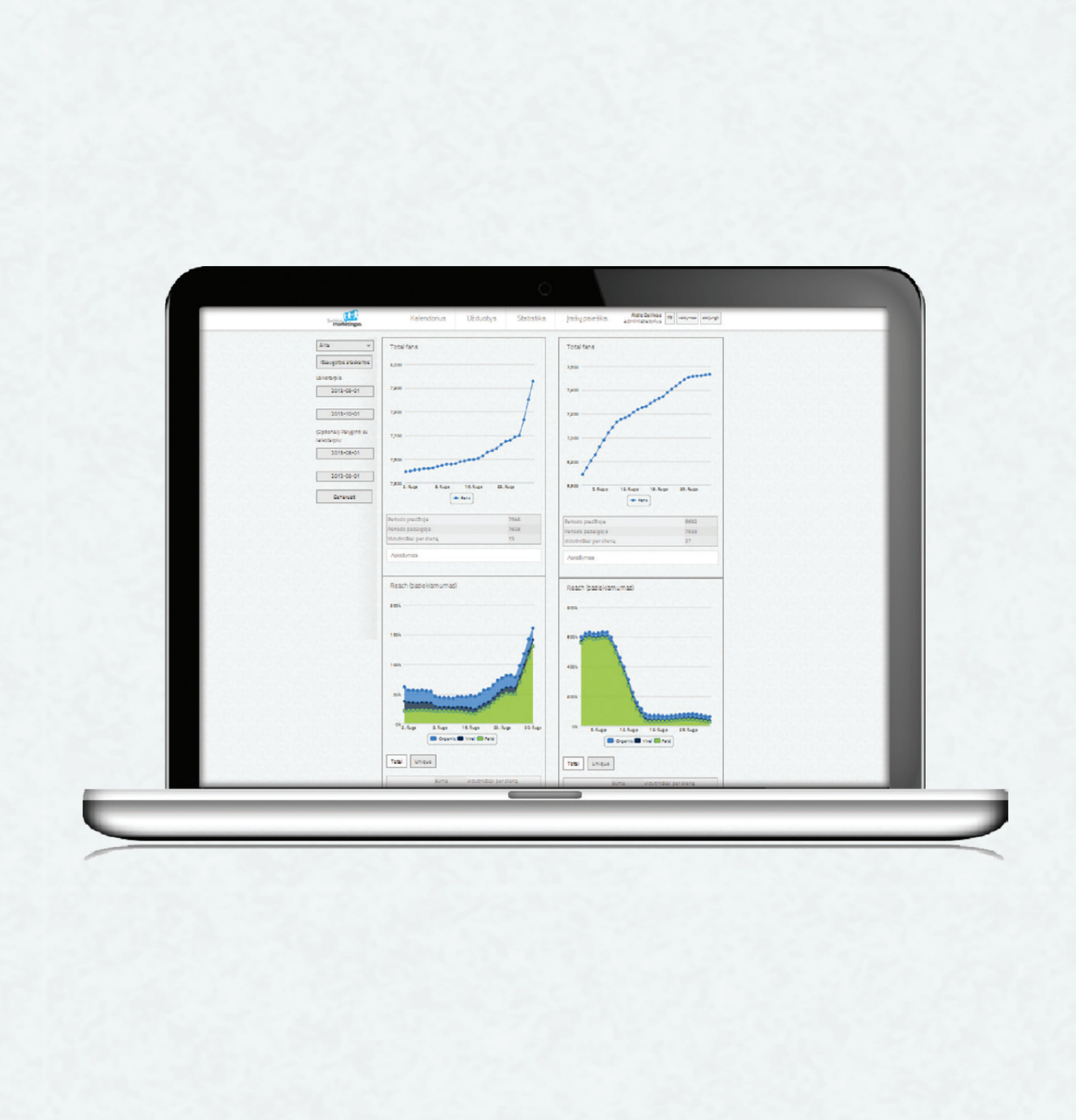
That was probably one of the first attempts to use Facebook’s then-just-announced Graph API and go a bit deeper into the numbers - to have more flexibility with how we interpret them, instead of just relying on Facebook’s own very limited-at-the-time reporting.
Then of course the platforms grew. Measurement and analysis became more and more sophisticated, and the tools they offered became more and more user-friendly. The algorithms got more sophisticated, and in turn the tools became less and less needed. The measurement, instead of serving a prediction purpose, turned into a signals monitoring exercise.
Measurement taken to an extreme
What I see happening now is that measurement has been taken to an extreme. A lot has changed with the way the platforms distribute content, and what matters now is probably much more opaque. When you had your audience clearly defined and you were certain on who would see your posts, who your audience was, and how you could reach outside of that audience, it was much easier to say: “OK, so this is the data, this is what I’m testing, this is the hypothesis, and this is how I disprove it.”
Right now the amount of content has become overwhelmingly higher than before. The algorithms that manage that content - what gets into users’ feeds - have become completely opaque.
What advertisers are doing though, is, in large part, still relying on the same methods we used to rely on a decade ago. The biggest talking point I hear is testing. When I talk to performance marketers, they all say we should test more, we should produce more content so we can iterate quickly on what works and kill what doesn’t. I agree that this is necessary.
But for me, most of that “testing” is just a different word for spray and pray.
There is no strategy behind it. There are tactics, which are usually to look at what the competitors are doing, try to guess or predict which content of theirs is performing best - either with the help of various tools or your own intuition - and then copy that content with minor modifications to see what works for you.
What that produces is a snake eating its own tail. An endless loop of copying, because obviously the competitors are doing the same thing. You’re looking at them. They’re looking at you. Everyone’s converging in the middle.
Once in a while somebody does something completely out of the box, and if it performs well, people start copying that too.
That’s it. We can’t afford actual experiments.
I’m betting, though, that the brands who do take experiments seriously - the ones who not only become good at reading signals of what was working previously but also have some rudimentary capability of predicting what should be working next, who read broader market signals than just their closest competitors - those brands are going to be the winners.
Empty calories
What’s easily measurable might not be as important, and what is important might not be as easily measurable.
It’s worth trying though.
Optimising performance without diving deep into the “creative” part is like optimising your stock portfolio without looking into what individual companies in it actually do. Without searching for patterns and meaning there. We play the numbers game, which might help us in the short term, but it does nothing to build a longer term strategy. We’re playing roulette pretending that we have an insight to what number will come next.
I’m not going to get into the more substantial discussions about branding, positioning, making your brand mean something - all that stuff. This is another can of worms that most of performance marketing is completely ignoring, and in many of the successful cases stumbles into by accident. Today, let’s just focus on the fixable issues we could easily change now with the help of technology.
Technology created the problem. It can also offer the solution.
It’s hard for a human to synthesize what’s happening in the market, get a sense of the general trend, and decide how to sync with it - or how to stand out completely. There’s just too much content, too many formats, too many vibes happening at once. We’re not built for that scale of pattern recognition.
But what if we stopped pointing AI at the dashboard and pointed it at the work instead?
What if?
Right now we’re using AI to analyze the hell out of every performance number. CTR, CPA, CPM, ROAS, hook rate, hold rate, thumbstop. Fine. That part is basically solved. The numbers go up or the numbers go down, and we know within hours.
What we don’t do is point AI at the thing that actually causes those numbers - the creative itself. The vibe of it. The pacing. The sound. The emotional register. The visual language. The stuff a strategist used to spend a whole afternoon staring at a wall of competitor ads trying to absorb through their pores.
So what if we did?
What if, instead of treating every ad as a black box that either works or doesn’t, we treated it as a set of attributes that can be described, classified, and compared? Not whether it’s good or bad - that’s the wrong question, and it’s also the one humans are worst at agreeing on. But whether the call to action is prominent or buried. Whether the emotional register is earnest or ironic. Whether the pacing is fast or slow. Whether the sound design is rich or thin. Concrete things. Things two people can look at and (roughly) agree on.
My guess is you’d land on a set of attributes. Some simple - does it have a CTA, yes or no, how original is it on a scale of whatever. Some more subjective but still measurable - emotional tone, register, the kind of stuff a thoughtful strategist would try to systematise after watching fifty ads in a row.
Then what if we let AI do the watching?
An agent that looks at every frame of every video. Transcribes it. Catches the visual cues - the framing, the color, the body language. Understands what’s being said, when, and why. Does this across a basically infinite amount of content - not just your competitors, not just your vertical, but the broader market you’re actually fighting for attention in. (This only works, by the way, if you’re feeding it the right content. Which is its own problem, and the reason platform access and data partnerships matter so much…)
Now you have a map of the market. Not a leaderboard of who’s winning - a map of how the winners look, sound, and feel, attribute by attribute.
Then you do the same thing to your own content. Same attributes, same scoring, same lens. And you overlay the two maps.
And suddenly you’re not just stating “this ad worked and this one didn’t, let’s make more like the one that worked.” You are instead asking “our content sits here on emotional register and here on pacing and here on sound design - the market is over there. Do we want to close the gap, or do we want to deliberately stand out by going the other way?”
That’s the kind of question strategists are supposed to be answering, and the kind they almost never get to, because they’re too busy looking at yesterday’s CTR.
The trap inside the solution
Obviously this can go wrong. Used badly, a tool like this just becomes one more dashboard. One more thing to measure, one more set of numbers to optimize toward, one more flavor of the same loop. Congratulations, you’ve now automated the snake.
The way out - and this is the part I keep coming back to - is to use the same AI not just to measure the market, but to interrogate it. Train an agent on what actually makes a good UGC ad. What makes a Pinterest pin land. What the elements are, what the objectives are, what the patterns are underneath the surface. Then ask that agent to ask you hard questions. Provocations. “Your sound design scores in the bottom quartile of the market - is that a choice or an oversight?” “Every top performer in your category opens with a face in the first 0.5 seconds. You don’t. Why?”
You still need a human to decide. You still need someone with taste and instinct and a point of view about the brand. But now that human has hypotheses instead of hunches. They have criteria that will prove or disprove what they’re trying. They have a sense of where the market actually is, not just where their three closest competitors are.
They can stop being accountants.
They can go back to being advertisers.
I’ve been playing with this idea for a while now, and building it out. The first versions show a lot of promise.
I’ll let you know how it goes.